
President Eisenhower once said, "Things are more like they are now than they ever were before"… years later, President Ford misquoted him. In the 1930's America was mired in the midst of the Great Depression. Millions had lost their jobs, their homes, their savings and their dreams. The banking system was in chaos and the stock market was in freefall. The U.S. Government under President Franklin Roosevelt instituted a massive campaign to give relief to the unemployed, reform business and financial practices and promote the recovery of the economy. His program included the building of bridges, roads, parks and schools with Federal funds in order to create new jobs.
It was during these troubled times that an undersized brown race horse rose from obscurity to capture the hearts and minds of America. Purchased for $8,000 from his original owners, Seabiscuit, under the tutelage of former cowboy, Tom Smith, began his climb to racing greatness. That climb was not without setbacks. Never taken seriously by the Eastern racing establishment and disparaged as just a "California" horse, Seabiscuit proved himself time and again on both coasts, but it wouldn't be until his meeting with War Admiral that he would be recognized as one of the greatest race horses of all time.
After his loss in Santa Anita's "hundred grander," Seabiscuit figured as a 4 to 1 underdog against Triple Crown winner War Admiral, when he took that long train ride from California to Baltimore's Pimlico Race Course for what was dubbed as the "Match of the Century". Red Pollard, Seabiscuit's regular rider, was recovering from a leg injury caused by a riding accident so Canadian born jockey George Woolf was chosen to replace him.
On that fateful day in November, 1938, 40,000 people crowded the grandstands and infield at Pimlico for the 1 3/16 mile race and another 40 million people listened to the race on the radio (for you younger readers, startling as it may seem, TV and the internet had yet to be invented). Although most were betting on War Admiral, in their hearts they were rooting for the Biscuit, and he didn't let them down. Seabiscuit won that race by 4 clear lengths and from such an inauspicious start, became an unlikely champion and a symbol of hope to the average man during the depression.
Flash forward seventy plus years, America is mired in, if not the Great Depression, at least the Great Recession. Millions have lost their jobs, their homes, their savings, and their dreams. The banking system is in chaos and the stock market in freefall. The U.S. Government under President Barack Obama has instituted a massive campaign to give relief to the unemployed, reform business and financial practices and promote the recovery of the economy. His program includes the building of bridges, roads, parks and schools with Federal funds in order to create new jobs.
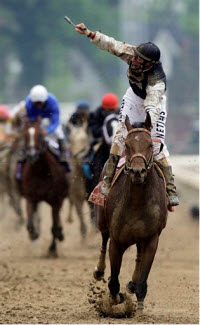
It is during these troubled times that an undersized brown race horse has risen from obscurity to capture the hearts and minds of America at the 135th running of the Kentucky Derby. Purchased at auction for $9,500, Mine that Bird, under the tutelage of former cowboy, Bennie Woolley Jr., has begun what we can only hope is his climb to racing greatness. His journey too has had its setbacks. Not taken seriously by the racing elite, disparaged as just a "Canadian" horse, Mine that Bird was a 50 to 1 longshot after his loss at Santa Anita's Breeders' Cup Juvenile when he began that long van ride from New Mexico to Kentucky. Given an incredible ride by jockey Calvin Borel, Mine that Bird proved himself at Churchill Downs, coming from last in a 19 horse field to win by the second largest margin in Derby history.
But it won't be until his meeting with this year's Preakness field that he has a chance to be recognized as a legitimate champion. On the third Saturday in May, 2009, once again people will crowd the grandstands and infield at Pimlico for a 1 3/16 mile race. Once again our underdog will be without his regular rider, only this time it's his trainer, not his jockey who is recovering from a leg injury caused by a riding accident (motorcycle this time, they weren't around back in the day). Once again, though the majority of people will be betting on other horses, we believe that they'll be secretly rooting for the Bird, because after all, don't we need another hero?
C Wayne is the Executive Vice President of Picks and Plays, Inc. and a noted author and lecturer on horse racing and internet gaming. He cordially invites you to visit Picks and Plays to receive free membership and a free daily handicapping report from the Best in Handicapping.